
25. August 2025
Press release
– Cluster of Excellence “CARE: Climate- And Resource-Neutral Civil Engineering” by RWTH Aachen University and TU Dresden
– The win of the bauma Innovation Award 2025 in the category of Research for MAXX – Mobile Assembly X-System
– Five years of Reference Construction Site, RWTH Aachen
– Seven years of Center Construction Robotics, RWTH Aachen
– Ten years of Chair of Individualized Production, RWTH Aachen
The CARE Cluster of Excellence: Climate- And Resource-Neutral Civil Engineering, which will be funded from 2026 as part of the federal and state excellence strategy, is a significant success for RWTH Aachen University. Science Minister Ina Brandes: “The modernization of our infrastructure is one of the key issues for the future in Germany. Construction must become faster, more ecological and more digital. This is one of the reasons why the state government of North Rhine-Westphalia supported CARE in its application for the Cluster of Excellence. The research in the real-world laboratory is an excellent example of how our scientists’ ideas have great potential to become a successful business model. North Rhine-Westphalia will benefit from CARE as a centre of science and business.”
In cooperation with researchers from TU Dresden (spokesperson Prof. Viktor Mechtcherine, Institute of Construction Materials) and RWTH Aachen University (spokesperson Prof. Martin Claßen, Chair and Institute of Structural Concrete), CARE’s mission is to transform key areas of civil engineering by developing and applying innovative and sustainable materials, forward-thinking design and measurement approaches, and advanced manufacturing technologies. “We are delighted that climate-neutral construction is now part of RWTH’s excellence. Over the next seven years, we will be developing technologies for circular construction systems and climate-neutral concrete, thereby making an important contribution to climate neutrality in the construction industry. Platforms such as the ‘Reference Construction Site’ create unique conditions for upscaling and knowledge transfer to industry that are only available in Aachen,” Professor Claßen is convinced.
Since its establishment in 2020, the Reference Construction Site has played a significant role in transforming the construction industry. Spanning 4,000 m², it serves as a test site, demonstration project and real-world laboratory, researching communication and data interfaces, and the digitalization and automation of construction sites and processes. The RWTH Aachen University Reference Construction Site is a pioneering project and the first 5G-equipped construction site in Europe designed for research and teaching purposes. It is used to test various communication technologies and the use of cyber-physical systems in a dynamic, real-life environment. An interdisciplinary team of scientists from RWTH Aachen University test robotic technologies, software solutions, and innovative teaching, working, and communication approaches under real-life conditions in close cooperation with European and local industry partners. This should help overcome the current challenges of digitization and address the circular economy requirements of the construction industry. “Our young researchers have the unique opportunity on the Reference Construction Site to reinvent and shape their future workplaces in the construction sector—together with our industry partners and the unique research network of RWTH”, says Prof. Sigrid Brell-Cokcan, Chair of Individualized Production, Scientific Director of the Center Construction Robotics and initiator of the Reference Construction Site.
Since the beginning of collaborative research within the RWTH Aachen Campus ecosystem, the Center Construction Robotics (CCR) has attracted an increasing number of project partners to explore future-relevant topics and develop solutions to current challenges, such as material reuse, digitization and automation in the construction industry. “As a founding member, it is impressive to see the groundbreaking development the Center Construction has under-gone in just seven years. For us at Autodesk, this place has long been more than just a location. It is an international think tank for the construction industry, a center for innovation, research, and visions of the future. What is being created here sets standards for a leading construction industry in Germany and inspires our customers worldwide,” says Ralf Mosler, Leader BIM Transformation, AEC Global Business Development, Autodesk. The European industry consortium currently includes companies such as EIFFAGE, ALIMAK GROUP, Autodesk GmbH, Casais Construction, Fundermax GmbH, Jekko Cranes, KUKA DEUTSCHLAND GMBH, LEONHARD WEISS GmbH & Co. KG, PORR AG, and UNIBERG GmbH.
Of particular note are the collaborative research projects, in which real demonstrators are being developed on the Reference Construction Site in partnership with industry partners. One such project is the ‘MAXX – Mobile Assembly X-System’, which won the bauma Innovation Award 2025 in the research category. This project impressively illustrates the collaboration between companies and universities across various value chains. ‘We are delighted with our joint success at bauma 2025 – a real achievement for our collaboration — and we will now continue this work as a new member of the Center Construction Robotics,’ says Carsten Bielefeld, CEO of Jekko Deutschland GmbH. The MAXX demonstrator is the first plug & produce solution that enables semi-automated, scaffold-free assembly. Fundermax panel assembly is currently a first prototypical application for scaffolding-free facade renovation. The MAXX system will be flexible for projects of any size and supports further renovation activities with interchangeable tools. The project was funded by the “Digitization of the Construction Industry and Innovative Construction” initiative of the Ministry of Home Affairs, Local Government, Building, and Digitization of North Rhine-Westphalia and developed with the support of the Center Construction Robotics at RWTH Aachen University and its industry partners Fundermax GmbH, KUKA AG, and Jekko Srl.
Overall, the Reference Construction Site provides a unique opportunity to conduct participatory research into innovative construction processes and technologies in real conditions, through close collaboration between academic institutions and industry partners. During “Open-Campus-Week”, interested parties are given free access to the Reference Construction Site and can exchange ideas with sponsors and project partners. Ralf Britz, Managing Director of BBL Baumaschinen, emphasises: ‘Our collaboration extends far beyond the Reference Construction Site. A particular highlight of the TARGET-X project was our joint appearance at bauma 2025, where we developed and presented a semi-autonomous crane with our partners.’
The Reference Construction Site is currently being funded by programs such as InnoNT – Innovative Network Technologies from the Federal Ministry of Transport (BMV), Smart Networks and Services Joint Undertaking as part of Horizon Europe, and the Ministry of Home Affairs, Municipal Affairs, Building, and Digitalization of the State of North Rhine-Westphalia.
Quotes


The Center Construction Robotics closes the digital gaps in the construction industry from planning through production to realization. In an interdisciplinary and consortial alliance of international industrial companies and cross-faculty institutes at RWTH Aachen University, intelligent processes, machines, and business models are being developed and designed for this purpose across the entire construction value chain. Jointly, the center researches and develops key technologies in hardware, software, and process design. In the process, not only the indirect planning processes, but also the entire construction site, which form an essential part of the construction industry, are taken into consideration, rethought, disruptively designed, and implemented. www.construction-robotics.de
Building Cluster | RWTH Aachen Campus
The Construction cluster develops and tests new technologies and materials for deployment in construction. The productivity of materials, labor, and equipment on site is optimized, and on-site execution is improved and accelerated through integrated planning tools and automation. This will enable more efficient and faster execution of what have been, in some cases, very lengthy approval and launch processes. In the future, a combination of artificial intelligence and machine learning can take construction to the next level of development. To make productive, digital tools usable, the cluster is also dedicated to the corresponding qualification of employees. https://www.rwth-campus.com/forschung/cluster-bauen/
The Members
Since the start of the initiative, the Reference Construction Site has been attracting more and more industry partners. The consortium includes well-known companies such as EIFFAGE, ALIMAK GROUP, Autodesk GmbH, Casais Construction, Fundermax GmbH, Jekko Cranes, KUKA DEUTSCHLAND GMBH, LEONHARD WEISS GmbH & Co. KG, PORR AG, UNIBERG GmbH. They support the Reference Construction Site financially, infrastructurally and with expertise from practice.
The projects
Since the start of the Center Construction Robotics more than five years ago, numerous projects have been initiated, implemented and already completed on the Reference Construction Site. Here is a current selection of 2024/25:
Cluster of Excellence CARE: Climate-Neutral and Resource-Efficient Construction
CARE’s mission: Building sustainably, innovatively, and future-oriented
How we build today shapes the world of tomorrow – ecologically, economically and socially. Conventional concrete and cement account for around 80 percent of the materials used in construction and cause more than eight percent of global CO₂ emissions. The Cluster of Excellence CARE aims to fundamentally transform key areas of construction through the development and application of innovative and sustainable materials, forward-looking approaches to the design and dimensioning of structures, and advanced manufacturing technologies. To meet the current challenges, scientists at TU Dresden and RWTH Aachen University are conducting research in the Cluster of Excellence CARE on climate-friendly building materials, new construction principles, and advanced manufacturing technologies, incorporating digital technologies and sustainable framework conditions. Five specialized research areas are working toward a shared vision: the construction of the future should be durable, efficient, and responsible—with scalable, affordable, and climate-resistant building solutions that can be used worldwide.
TARGET-X
TARGET-X aims to strengthen key economic sectors in Europe by integrating 5G and 6G and to accelerate the digital transformation. TARGET-X pursues this vision by providing testbeds for different domains (energy, automotive, construction, manufacturing, and robotics). The development is expected to lead to new business models. The project brings together information technology providers, operational technology providers, and SMEs in a European context. The Reference Construction Site of RWTH Aachen University is one of the 5 European real-world laboratories, which is an ideal test environment for 5G and 6G processes. The TARGET-X project has received funding from the Smart Networks and Services Joint Undertaking (SNS JU) under the European Union’s Horizon Europe research and innovation program under grant agreement No 101096614.
The project is supported by the Fraunhofer Institute for Production Technology (IPT), ERICSSON GmbH of RWTH Aachen University through the three chairs (Chair of Individualized Production, Machine Tool Laboratory WZL and Institute for Automation of Complex Power Systems), IDIADA Automotive Technology SA, Construction Robotics GmbH, Fundacio Privada I2CAT, Internet I Innovacio Digital a Catalunya, Marposs Societa Per Azioni, Fundingbox Accelerator SP. z o. o, Ericsson Arastirma Gelistirme ve Bilisim Hizmetleri Anonim Sirketi, Marposs Monitoring Solutions GmbH, 5G Communications for Future Industry Verticals SL, Neutroon Technologies S.L, Mitsubishi Electric Europe B.V. German Branch, FundingBox Communities SL and Qualcomm CDMA Technologies GmbH.
EConoM
EConoM is a research project funded until 30.04.2025 by the German Federal Ministry of Digital and Transport (BMDV) as part of the InnoNT funding call, which is supported by the project funding agency TÜV Rheinland Consulting GmbH. To secure the German and European construction industry and to promote Germany as a location for technology and innovation, research and development into the automation of construction sites is essential. The combination of key technologies from 5G campus networks, edge computing, artificial intelligence, and digital twin will enable enormous automation potential and further optimization of workflows and processes within the construction site.
As part of EConoM, innovations in the areas of artificial intelligence (AI) and 5G campus networks will be used to improve the quality of construction work, increase work safety on the construction site, reduce overall costs, and shorten construction times. To achieve this, edge computing, AI, and communication must be made possible on construction sites in a comprehensive, robust, easy-to-use, and trouble-free manner. It is coordinated by the partners Fraunhofer FOKUS, Fraunhofer Heinrich Hertz Institute, HOCHTIEF ViCon GmbH, planen-bauen 4.0 GmbH, UNIBERG GmbH, Zeppelin Rental GmbH, Construction Robotics GmbH, TÜV Rheinland and Chair of Individualized Production, RWTH Aachen University.
ROBETON II
The ROBETON II project is based on a promising approach to resource-efficient and circular construction. In the ROBETON project, a robot-assisted sawing process was developed that enables the dismantling of existing reinforced concrete walls into modular components that can then be reinstalled. To make this approach practicable, the ROBETON II project aims to develop the fundamentals regarding the requirements for load-bearing capacity, durability, and freedom from harmful substances for the implementation of the process. ROBETON II aims to reuse components that meet the requirements of new buildings. To this end, three objectives are being pursued: First, the cutting process is to be optimized to create form-fitting joints. Second, possible contamination of the components by sawdust, process water, and air or dust samples is to be checked. Thirdly, non-destructive testing methods for the concrete elements to be dismantled are being tested and validated. The investigations are necessary to develop strategies for the practical application of the process and to identify potential approval and reuse options for the components. This project is funded by the Federal Institute for Research on Building, Urban Affairs and Spatial Development (BBSR) on behalf of the Federal Ministry of Housing, Urban Development, and Construction (BMWSB) with funds from the Zukunft Bau Research Fund (project no.: 10.08.18.7-24.47).
MAXX – Mobile Assembly X-System
The renovation of building envelopes is gaining increasing market potential from an economic and sustainability perspective and is facing increasingly drastic challenges due to the shortage of qualified workers. By 2030, the market potential for building envelope renovation is estimated at €400 billion, with a demand for over 300,000 employees. This corresponds to an increase of over 50 percent of the current number of employees, which under normal circumstances can hardly be met.
The Center Construction Robotics aims to automate the renovation of building envelopes using construction robotics, thereby counteracting the shortage of qualified workers. Fundermax panel installation is currently the first prototype application for scaffold-free facade renovation. The MAXX system will be suitable for projects of all sizes and supports further renovation activities with interchangeable tools. It contributes to building maintenance and promotes the circular economy. Sustainable and semi-autonomous renovation processes are made faster and safer. MAXX – Mobile Assembly X-System is the ideal partner for renovation professionals. In the future, it will keep workers out of danger zones and make their work easier. For over two years, the project team has been working on the further development of an assistance system for the automated assembly and handling of facade panels for building renovation, thus contributing to the construction site of the future. The project was funded by the “Digitization of the Construction Industry and Innovative Building” initiative of the Ministry of Home Affairs, Municipal Affairs, Building and Digitization of North Rhine-Westphalia (NRW) and was developed with the support of the industry partners of Center Construction Robotics at RWTH Aachen, including Fundermax GmbH, KUKA AG, and Jekko Srl.
KI for BauChain
AI-based data collection and processing for building materials in a digitized construction process chain.
On construction sites, the control, ordering, inspection, storage, and provision of delivered goods must always be carried out in close coordination with the construction processes. Small disruptive factors at the beginning have an increasingly strong impact as the process chain progresses. The consequences are mainly delays and cost overruns. One approach to eliminating disruptive factors at the beginning of the process chain is to monitor the delivery status of goods, but this can be time-consuming and resource-intensive. Material information is usually recorded in paper form, does not reflect the current status on the construction site, and is no longer available in further steps of the process chain. By digitally recording material information using AI methods, it can be cataloged and reused in real time. Semantically described, the recorded data can be integrated into the higher-level process control of the construction site.
For this purpose, process modeling methods based on linked data developed at the Chair of Individualized Construction Production are applied. They enable the integration of the collected information into a higher-level digital image of the construction site, including all process-relevant data, and thus agile process control. The use of AI methods enables the recording and cataloging of building materials as well as the volume estimation of bulk materials through 2D- and 3D-image analysis. Data collection and processing are being tested in the real-world laboratory of the RWTH Aachen Reference Construction Site using simulated delivery processes. The project is funded and supported by the Federal Institute for Research on Building, Urban Affairs, and Spatial Development as part of the Zukunft Bau Research Fund program (project no.: 10.08.18.7-22.15).
OnTimeOlogie
Construction traffic data ontology for efficient data-based construction project management
In the traffic sector, different players use different data sources and collect various information that is often only available to a limited extent or with delays. This fragmentation of data makes efficient collaboration and decision-making difficult. To fully exploit the potential of the available data, comprehensive utilization through linked data is necessary, which benefits all stakeholders. OnTimeOlogie aims to enable format-independent linking of different data sources from traffic data and construction projects. Through the development of a semantic model and the use of ontologies, construction-specific data from infrastructure projects will be linked with information from the federal government’s mobility library in a dynamic semantic context. This should create potential for various construction companies, municipalities, and road users, and accelerate construction projects. First, an analysis of inventory data from various sources will be carried out, followed by the collection of specific requirements for accelerating infrastructure projects based on traffic data. A conceptual data model links external online data with construction project data. Feasibility will be verified by implementing an ontology framework, while the potential for various stakeholders will be validated by means of external cost analyses. Project partner: HOCHTIEF ViCon GmbH. Associated partners: Federal Highway Research Institute (BASt), City of Aachen. This project is funded by the Federal Ministry of Transport (BMV) as part of the mFUND innovation initiative (FKZ: 19F1219A).
Praxisleitfaden
The guideline for information networks in construction promotes the dissemination of digitally-based and innovative construction methods by conducting and documenting a detailed application-oriented analysis of the necessary digital prerequisites.
The aim is to enable the systematic selection and establishment of an information network for specific applications in construction practice. This creates a basis for the implementation of digital construction methods along the entire construction process chain, such as efficient planning through a priori simulation, the execution of control commands by automated construction machines, or the sensor-based recording of target variables in the actual process for computer-aided evaluation and optimization. For users with little expertise in network technology, the guide also offers easy access to digital technologies that are becoming increasingly important in practice. These results are also being incorporated into the development of a VDI expert recommendation on the requirements for a high-performance IT infrastructure for construction site automation, as well as publications with the German Association for Project Management in the Construction and Real Estate Industry. As part of the cooperation with numerous partners from the construction industry, the project provides knowledge and experience from the industry for the industry. The project is funded by the “Digitization of the Construction Industry and Innovative Construction” initiative of the Ministry of Home Affairs, Local Government, Building, and Digitization of North Rhine-Westphalia. (Project no.: 35.05.04.01-IP-2022-007).
Press photos
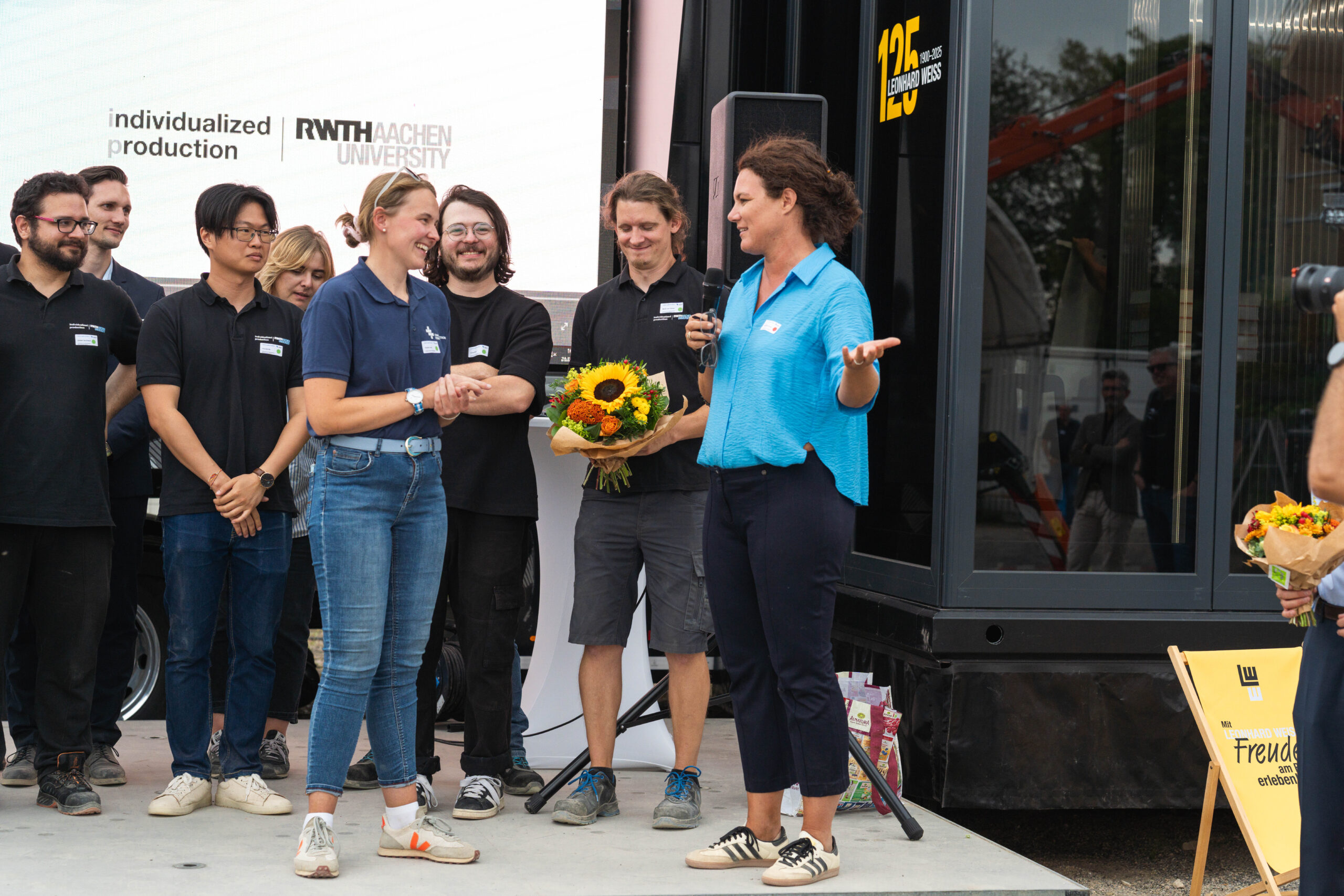
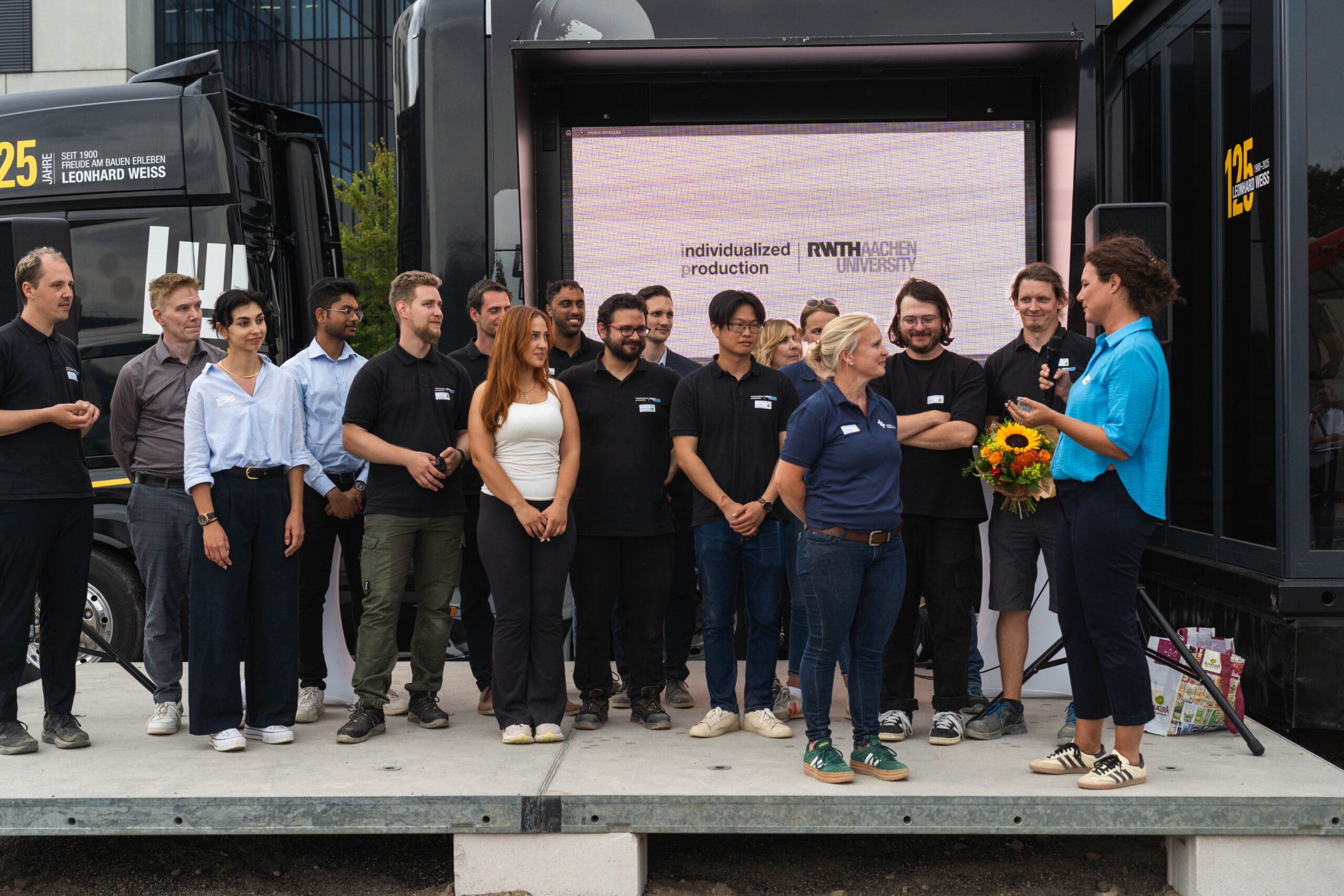
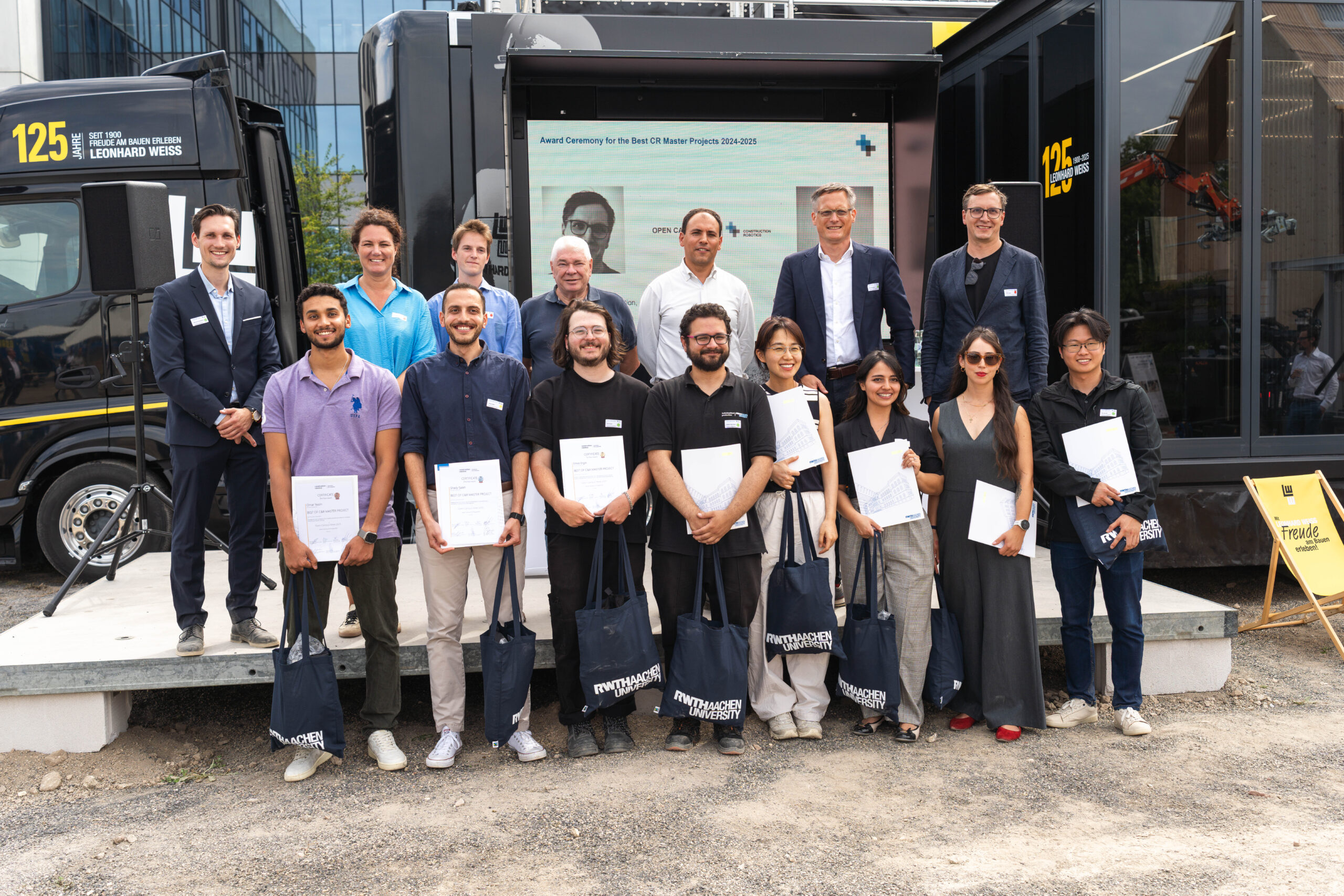
High-resolution images of our event on August, 26 and the Reference Construction Site can be downloaded here. Please note the stated copyright “CCR / Steindl”. This image material may only be used for editorial purposes in the context of reporting on the event on 26.08.2025/the Reference Construction Site and with the specified copyright (CCR / Steindl). In the event of publication, please send us a specimen copy or a Links to the online article.
-

CCR/Steindl
-

CCR/Steindl
-

CCR/Steindl
-

CCR/Steindl
-

CCR/Steindl
-

CCR/Steindl
-

CCR /Steindl
-

CCR/Steindl
-

CCR/Steindl
-

CCR/Steindl
-

CCR/Steindl
-

CCR/Steindl
-

CCR/Steindl
-

CCR/Steindl
-

CCR/Steindl
-

CCR/Steindl
-

CCR/Steindl
-

CCR/Steindl
-

CCR/Steindl
-

CCR/Steindl
-

CCR/Steindl
-

CCR/Steindl
-

CCR/Steindl
-

CCR/Steindl
-

CCR/Steindl
-

CCR/Steindl
-

CCR/Steindl
-

CCR/Steindl
-

CCR/Steindl
-

CCR/Steindl
-

CCR/Steindl
-

CCR/Steindl
-

CCR/Steindl
-

CCR/Steindl
-

CCR/Steindl
-

CCR/Steindl
-

CCR/Steindl
-

CCR/Steindl
-

CCR/Steindl
-

CCR/Steindl
-

CCR/Steindl
-

CCR/Steindl
-

CCR/Steindl
-

CCR/Steindl
-

CCR/Steindl
-

CCR/Steindl
-

CCR/Steindl
-

CCR/Steindl
-

CCR/Steindl
-

CCR/Steindl
-

CCR/Steindl
-

CCR/Steindl
-

CCR/Steindl
-

CCR/Steindl
-

CCR/Steindl
-

CCR/Steindl
-

CCR/Steindl
-

CCR/Steindl
-

CCR/Steindl
-

CCR/Steindl
-
CCR/Steindl
-

CCR/Steindl
-

CCR/Steindl
-

CCR/Steindl
-

CCR/Steindl
-

CCR/Steindl
-

CCR/Steindl
-

CCR/Steindl
-

CCR/Steindl
-

CCR/Steindl
-

CCR/Steindl
-

CCR/Steindl
-

CCR/Steindl
-

CCR/Steindl
-

CCR/Steindl
-

CCR/Steindl
-

CCR/Steindl
-

CCR/Steindl
-

CCR/Steindl
-

CCR/Steindl
-

CCR/Steindl
-

CCR/Steindl
-

CCR/Steindl
-

CCR/Steindl
-

CCR/Steindl
-

CCR/Steindl
-

CCR/Steindl
-

CCR/Steindl
-

CCR/Steindl
-

CCR/Steindl
-

CCR/Steindl
-

CCR/Steindl
-

CCR/Steindl
-

CCR/Steindl
-

CCR/Steindl
-

CCR/Steindl
-

CCR/Steindl
-

CCR/Steindl
-

CCR/Steindl
-

CCR/Steindl
-

CCR/Steindl
-

CCR/Steindl
-

CCR/Steindl
-

CCR/Steindl
-

CCR/Steindl
-

CCR/Steindl
-

CCR/Steindl
-

CCR/Steindl
-

CCR/Steindl
-

CCR/Steindl
-

CCR/Steindl
-

CCR/Steindl
-

CCR/Steindl
-

CCR/Steindl
-

CCR/Steindl
-

CCR/Steindl
-

CCR/Steindl
-

CCR/Steindl
-

CCR/Steindl
-

CCR/Steindl
-

CCR/Steindl
-

CCR/Steindl
-

CCR/Steindl
-

CCR/Steindl
-

CCR/Steindl
-

CCR/Steindl
-

CCR/Steindl
-

CCR
-

CCR
-

CCR
-

CCR
-

CCR
-

CCR
-

CCR
-

CCR
-

CCR
-

CCR
-

CCR
-

CCR
-

CCR
-

CCR
-

CCR
-

CCR
-

CCR
-

CCR
-

CCR
-

CCR
-

CCR
-

CCR
-

CCR
-

CCR
-

CCR
-

CCR
-

CCR
-

CCR
-

CCR
-

CCR
-

CCR
-

CCR
-

CCR
-

CCR
-

CCR